Wharton has moved away from a single long career-goals essay and now asks you to split your ambitions across two tightly capped short answers, and then make a case for your contribution to the community in one 350-word essay. The total word count is shorter than it used to be, but the bar is higher: With so few words, there is nowhere to hide a vague goal or a generic “I’ll join x, y, and z clubs” contribution.
If you’re pursuing a Wharton MBA, this is the moment to think clearly about both halves of the bargain—what you hope to take from the program, and what you intend to give back to it. Below, we walk through every current prompt, what the AdCom is really asking, and how to approach each one, drawing on the wisdom of one of Wharton’s own professors.

| Theme | Prompt | Word Limit |
| Career Goals (Immediate) | “What is your immediate post-MBA professional goal?” | 50 |
| Career Goals (Long-Term) | “Describe your medium- and long-term professional goals after your Wharton MBA.” | 150 |
| Community Contribution | “Taking into consideration your background—personal, professional, and/or academic—how do you plan to add meaningful value to the Wharton community?” | 350 |
Read on or click the links in the table to see our guidance on how to address each prompt.
Adam Grant is a professor of organizational psychology at the Wharton School and the author of several bestselling books. One of them, 2013’s Give and Take: A Revolutionary Approach to Success, deals with people Grant labels “givers” and “takers.” In a nutshell, a giver approaches interactions hoping to contribute something to someone else; a taker treats every interaction as a chance to extract something. Grant identifies a third category, “matchers,” who balance the two.
His central finding is counterintuitive: Givers account for both the most and the least productive people in a work environment. Some givers try so hard to please everyone that they burn out or fall behind. But others contribute in small, vital ways over time—providing useful feedback, making the right introduction—and make a whole community function better.
Grant adds a second axis, too: agreeable versus disagreeable. The most dangerous person in any organization, he argues, is the agreeable taker—someone so pleasant about giving nothing back that they go unnoticed. The most undervalued is the disagreeable giver—the gruff colleague whose feedback is harsh but genuinely meant to help. You can get a fuller picture from his TED Talk on the subject.
Why does this matter for your application? Because Wharton’s essay set is, in effect, built on the same dichotomy. The short answers ask what you want to take from the MBA—the goals you want to achieve, and the skills and network you need to reach them. The community essay asks what you’ll give. Strong applicants make both halves credible. Weak ones treat the whole application as a series of asks, forgetting that an admit is an investment Wharton expects to pay off—in the form of an active classmate, a generous alum, and an enthusiastic promoter of the school.
Let’s turn to the prompts with that framing in mind.

Each year, Menlo Coaching advises a small group of candidates applying to the M7 and other leading MBA programs.
We've been trusted by 2000+ applicants from MBB, Blackstone, Goldman Sachs, Amazon, and more.
With highly personalized guidance from experienced, full-time admissions consultants and unlimited, comprehensive packages, we help applicants submit winning applications.
Are you interested in becoming a client?
Treat the two short-answer boxes as a pair, both addressing the “take” side of the question. The first pins down where you’re headed immediately; the second shows the trajectory underpinning that first move. Together they should read as one coherent arc, not two disconnected statements.
Short Answer 1: What is your immediate post-MBA professional goal? (Text box, 50 words maximum)
What the AdCom is really asking: Can you name, concretely and without hedging, the job you intend to take right out of Wharton? 50 words is not enough space for a story; it’s barely enough for a precise answer, and that’s the point. The school wants to see that your plan is specific and feasible: a function, an industry, and ideally the type of firm or role.
How to approach it:
Short Answer 2: Describe your medium- and long-term professional goals after your Wharton MBA. (Text box, 150 words maximum)
What the AdCom is really asking: Does your immediate goal start you on a path toward something larger, and realistically attainable? This is where you outline the 3-to-5-year path you envision post-MBA and the longer-term vision it serves. Wharton admits students with achievable plans and a clear roadmap for achieving them from your specific starting point. This box is the roadmap.
How to approach it:
The “taker trap” to avoid: It is tempting to make these answers entirely about what you’ll gain. That’s reasonable—no one pursues an MBA without expecting to benefit. But the strongest short answers also suggest why you’re worth the investment: that your goals are realistic, that you’ll succeed, and that your success will reflect well on Wharton. Read your two boxes back to back and ask whether they make you look like a smart bet for the school.
Essay: Taking into consideration your background—personal, professional, and/or academic—how do you plan to add meaningful value to the Wharton community? (Text box, 350 words maximum)
This is the mirror image of the short answers. Where those were about what you’ll take, this essay is about what you’ll give. For this cycle Wharton reworded the prompt from “make specific, meaningful contributions” to “add meaningful value,” and trimmed the limit from 400 to 350 words. “Value” is broader than a single “contribution,” and invites you to discuss the cumulative effect you’ll have on classmates, clubs, and culture, not just one flagship initiative.
What the AdCom is really asking: Will you be an active, generous member of a student-led community—someone who makes the experience better for the people around you—or will you extract value and move on? Wharton’s culture runs on student leadership; clubs, conferences, and learning teams are built and sustained by students. The school is looking for future contributors.
How to approach it:
Topics to avoid here: Don’t restate your career goals (that’s the short answers’ job). Don’t offer the nondescript “I’ll bring a diverse perspective and join clubs” without specifics. And don’t list contributions that any applicant could claim; the more your “give” depends on your particular background and interests, the more convincing it is.
Applicants frequently look for examples of successful Wharton essays. A word of caution: A model essay is most useful for understanding structure in a broad sense—how a strong applicant moves from a concrete immediate goal to a credible long-term vision, or how they ground a community contribution in real precedent—and far less useful as a template to directly imitate. The fastest way to write a weak essay is to borrow the shape of someone else’s narrative. Wharton AdComs read thousands of essays and reliably detect the formulaic. Use examples to calibrate, but then try to write something only you could have written.
Realigning your mindset to that of a giver—while still making a crisp, confident case for what you want to take from the program—is the hallmark of a strong Wharton application. Nail both sides, and you emphasize what you have to offer the institution while subtly demonstrating your familiarity with its culture and philosophy.
Frankly, it’s a tricky path to walk alone. If you’re considering a Wharton application, reach out for a free consultation with one of our experienced MBA admissions coaches.

Yaron Dahan
Expert Consultant & Director, BD
Education: BA, MA
Since 2006, Yaron has been using his narrative knowhow—honed through his work as a screenwriter and formal training at the Sorbonne—to pull out the most compelling details from an applicant’s background. He’s helped applicants from many industries (with a speciality in PE and investment banking) win admission to all the top US and European MBA programs, including HBS, Stanford, Wharton, Columbia, Booth, LBS.
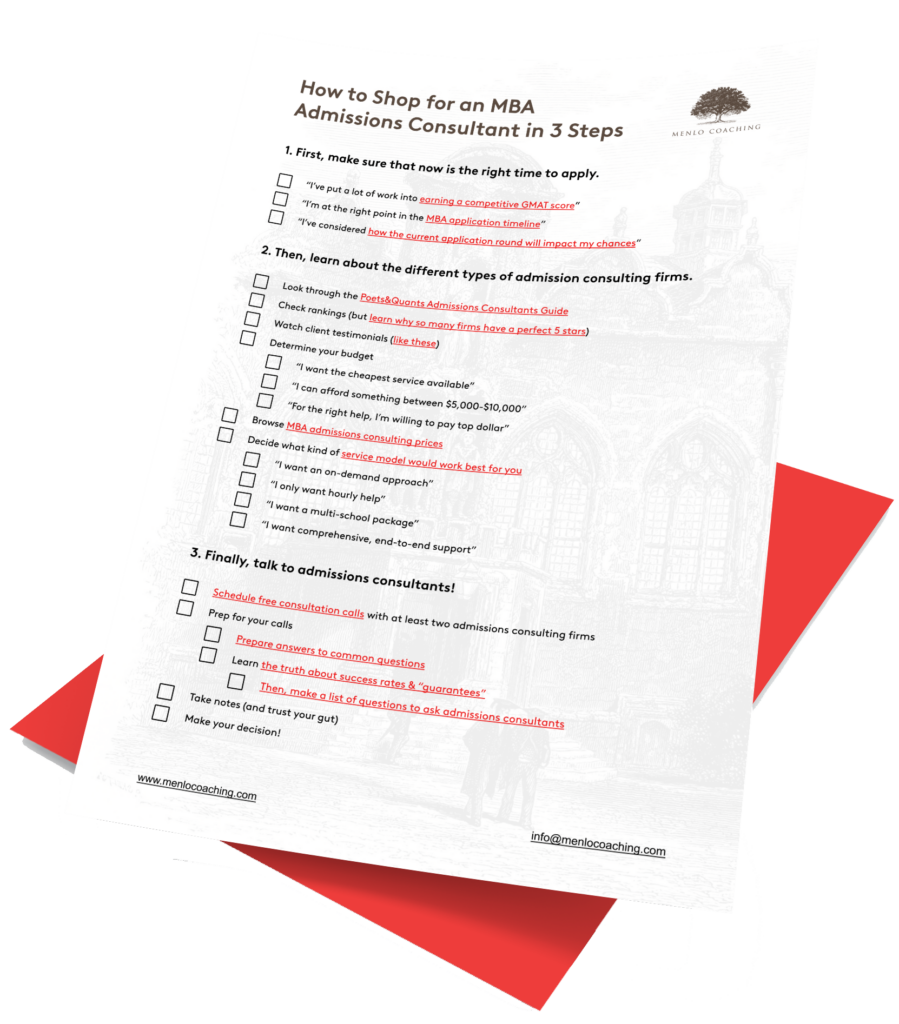
Our free, comprehensive checklist covers everything you need to shop for an MBA admissions consultant.