This guide walks through every essay of the UC Berkeley Haas MBA application, including the impromptu Haas video essay (which now opens with a brief self-introduction), the rewritten 300-word career goals essay, and the Distance Traveled essay, with prompt-specific strategy for each.
Briefly introduce yourself, then tell us what makes you feel alive when you are doing it, and why? (Impromptu video Essay, 2 minutes maximum)
Your video essay may be recorded on the next page. The video essay can be completed either before or after submitting the application. The latest deadline to record the video essay is 7 days after the round’s deadline. Video essays may not exceed 2 minutes. Applicants may record the video essay up to two times. However, if you choose to use the second attempt, the first recording will be deleted and cannot be submitted.
This section of the application requires a webcam and microphone. Please be sure you are in a quiet and well-lit environment before you begin. You are allowed 2 attempts to record your Video Essay, and your response can be no longer than 2 minutes. Before recording, you will be prompted to test your audio-visual connection. Follow the steps on-screen and check the box to confirm your successful completion of the audio-visual test. You will then be asked to confirm that you are ready to begin recording your Video Essay. Once you click the “Ready” button, the Video Essay question will appear and you will have 20 seconds (on-screen countdown) before recording begins. Once you have finished responding, click the “Stop” button. Note that the recording will end automatically at 2 minutes – the maximum video length – if you do not click the “Stop” button.
Note: this is an impromptu video recorded through the Haas application portal and NOT a video to be recorded in advance.
Haas adds: “Please share something about yourself that may not be evident in other parts of your application. We are looking for an authentic and introspective response that demonstrates how you will contribute to the MBA class and culture at UC Berkeley Haas.”
This is the component applicants most often misread, and this cycle Haas gave it two jobs instead of one: a brief self-introduction, then the real question.
The question is not “what are you good at” or “what will impress us.” It asks what energizes you, delivered impromptu, on camera, with a 20-second countdown and no script. Haas built its admissions process around four Defining Leadership Principles (Question the Status Quo, Confidence Without Attitude, Students Always, and Beyond Yourself), and the video is where the committee checks whether the person behind the written application is genuine and self-aware.
Haas’s own guidance for this cycle says it plainly: they want something that “may not be evident in other parts of your application.” They want to see a real human being light up about something real.
Budget the two minutes deliberately now that there are two parts. The introduction should take roughly 15 to 20 seconds: name, what you do, one humanizing detail, done. Every second spent reciting your resume header is a second taken from the answer that actually differentiates you.
For the main question, pick a genuine source of energy, not a strategically chosen one. The answer that works is specific and a little unguarded: a craft, a problem you can’t stop turning over, a way you spend time that has nothing to do with your resume. It works because the “why” reveals a value.
Ninety seconds is enough for one clear answer with a concrete example and the reason it matters to you. It is not enough for three hedged ones.
A few answers quietly hurt you here. “I feel alive when I close a deal” is the resume in disguise, and Haas’s commentary explicitly asks for what the rest of the application doesn’t show. “Solving complex problems” and “driving impact” are abstractions that say nothing and sound rehearsed; name the actual thing. And a memorized monologue is obvious on camera, undercutting the authenticity the format exists to test—if you keep falling into the same scripted opening, change your first sentence, which knocks you off the rails and back into natural delivery.

Each year, Menlo Coaching advises a small group of candidates applying to the M7 and other leading MBA programs.
We've been trusted by 2000+ applicants from MBB, Blackstone, Goldman Sachs, Amazon, and more.
With highly personalized guidance from experienced, full-time admissions consultants and unlimited, comprehensive packages, we help applicants submit winning applications.
Are you interested in becoming a client?
Because the prompt is impromptu, the real preparation is knowing your own material. Have two or three things that authentically make you feel alive in mind before you sit down, so the only thing left to do on camera is talk like yourself.
The mechanics are spelled out in unusual detail this cycle, so there is no excuse for a technical surprise. You complete an audio-visual test, confirm you’re ready, get a 20-second on-screen countdown, and recording cuts off automatically at two minutes. The video can be recorded before or after submitting, with a hard deadline 7 days after the round’s deadline.
Use the platform’s practice questions before your real attempt. Set up in a quiet, well-lit space with a clean background, and speak slowly — nerves push almost everyone to rush. You get two attempts, but treat the first as the real one, since choosing the second permanently deletes the first.
What are your post-MBA career goals, and how will the resources at UC Berkeley Haas help you achieve them? How do you plan to remain adaptable as your career evolves? (Text box, 300 words maximum)
Haas adds: “Essay responses should reflect your own ideas and experiences, be independently written, and reflect your writing style. You may receive advice on content and editing, including the use of generative artificial intelligence software to assist with readability, but content and final written text must be your own.”
Haas rewrote this prompt for 2026–2027, and the changes are worth reading closely. The old short-term/long-term framing is gone. In its place are three distinct questions packed into 300 words: what you want to do after the MBA, which specific Haas resources get you there, and — new this cycle — how you’ll stay adaptable when the plan meets reality.
The underlying incentive hasn’t changed. Haas wants to admit people with credible plans who will place well and reflect well on the program.
But the adaptability question adds a second test. In a market where post-MBA industries reshape themselves every few years, the committee wants evidence you can hold a concrete goal and adjust it intelligently, rather than clinging to a plan or, worse, having none.
Lead with a post-MBA goal specific enough to be believed: the function, the kind of organization, ideally the industry. Vague ambition (“a leadership role in tech”) remains the most common failure here. Name the actual next job.
Then notice that Haas asks about its resources, not “why an MBA” — an invitation to be concrete. Anyone can name two classes from the website, and parallel courses exist everywhere. Fit comes from connecting your goal to what Haas distinctively offers: its Bay Area position in tech and venture, its strength in sustainability, social impact, and entrepreneurship, and the specific communities or experiential programs that map to your path. Conversations with students and alumni read very differently from a catalog summary.
For the adaptability question, don’t answer with a platitude about embracing change. Point to a moment you’ve already adapted — a pivot, a role that evolved under you, a skill you rebuilt — and name what makes your goal robust: transferable skills, a network that spans industries, or the learning habits Haas itself celebrates in its Students Always principle.
One more note. Haas’s commentary this cycle is explicit that the essay must be independently written and in your own voice. AI may help with readability, but the content has to be yours, and a 300-word essay that sounds like everyone else’s defeats its own purpose.
At Berkeley Haas, we consider “distance traveled” as the contextual information that helps us understand the unique circumstances, challenges, or influences that have shaped your personal and professional journey.
We invite you to share aspects of your background, personal circumstances, or significant experiences that have meaningfully impacted who you are today and how you’ve reached this point. Please tell us how these experiences have influenced your perspectives, decisions, and aspirations, and how they contribute to the person you are becoming. (Text box, 300 words maximum)
“Distance traveled” is Haas’s framing for context. It asks the committee to read your accomplishments against the starting line you ran from, not in a vacuum.
This is the essay that does the work the resume can’t: it explains the circumstances, obstacles, or formative influences behind your trajectory. It connects directly to the Beyond Yourself principle and to how Haas thinks about who has the perspective to add to its community.
Note the second half of the prompt, which applicants routinely skip. It isn’t enough to describe what happened — you have to connect it forward, to how those experiences shaped your perspectives, decisions, and aspirations.
Choose context that genuinely shaped you and that the rest of your application doesn’t already reveal: a background, a constraint, a turning point, a responsibility you carried. Be concrete about the circumstances without turning the essay into a catalog of hardship. The point is not how much you suffered but how far you came and what it made of you.
Spend real words on the “becoming” half of the prompt. Tie the experience to a specific perspective you now hold or a decision it drove, including, where it fits, the goals you wrote about in the career essay.
Two cautions. First, don’t restate your resume; this is the story underneath the line items, not the line items again. Second, authenticity matters more than drama — a true, well-observed account of an ordinary-seeming circumstance beats an inflated one every time, and experienced readers can tell the difference.
List up to five significant community and professional organizations and extracurricular activities in which you have been involved during or after university studies. Include the following information for each using the format below:
- Org name
- Role
- Organization Size
- Start Date/End Date
- Hours per Week
- Description of Participation (Text box, 500 words maximum)
This supplemental section is where Haas looks for the Beyond Yourself principle in evidence: what you have actually done outside of work, and how deeply you committed to it. It is structured rather than narrative, but the “Description of Participation” fields are where you can show impact and leadership, not just attendance.
Choose for significance over quantity. Five shallow memberships read worse than two or three involvements where you clearly mattered.
In the descriptions, use the limited space to show concrete contribution and growth: what you built, led, or changed, and the scope of it. Hours per week and tenure quietly signal genuine commitment, so be accurate — sustained involvement is more persuasive than a title you held briefly.
Treat this list as part of the same portrait your essays paint. It should corroborate the values and energy you describe elsewhere, not introduce a disconnected second self.
Haas asks students “to question the status quo” and to lead with “confidence without attitude,” and its application is built to surface whether you actually embody those Defining Leadership Principles rather than just reciting them. The school is looking for people who pair rigorous analysis with emotional intelligence, who take intelligent risks, and who want to contribute to something beyond themselves.
That orientation runs through every component this cycle. The video essay tests whether you are a genuine, self-aware person who can speak for yourself unscripted; Distance Traveled tests the perspective you bring; the rewritten career essay tests whether your ambitions are both grounded and flexible enough to survive contact with a changing market.
The clearest way to demonstrate these qualities is to be specific and honest throughout: concrete stories, real motivations, and goals that connect credibly to what Haas offers.
Writing strong, coherent, genuine essays is an essential part of your Haas application. This cycle’s components reward applicants who can introduce themselves and think on camera, explain the context behind their trajectory, and connect clear goals to specific Haas resources while showing they can adapt when circumstances change. It is worth the time to write, and record, about experiences that are genuinely yours and that you truly learned from.
Wrestling with the Haas MBA admissions essays? Let our seasoned consultants alleviate the stress by providing expert guidance on essay crafting and take your application to the next level.

Lainie Blum Cogan
Sr. Consultant & Director
Education: BA, MA
Since 2008, Lainie has worked with a wide variety of MBA applicants, including dual-degree candidates, nonprofit entrepreneurs, PE professionals, and more. A published author, Lainie draws on her writing and storytelling abilities to help applicants target top programs, and her track record includes acceptances from every M7 program—plus hundreds of thousands of dollars in scholarship awards.
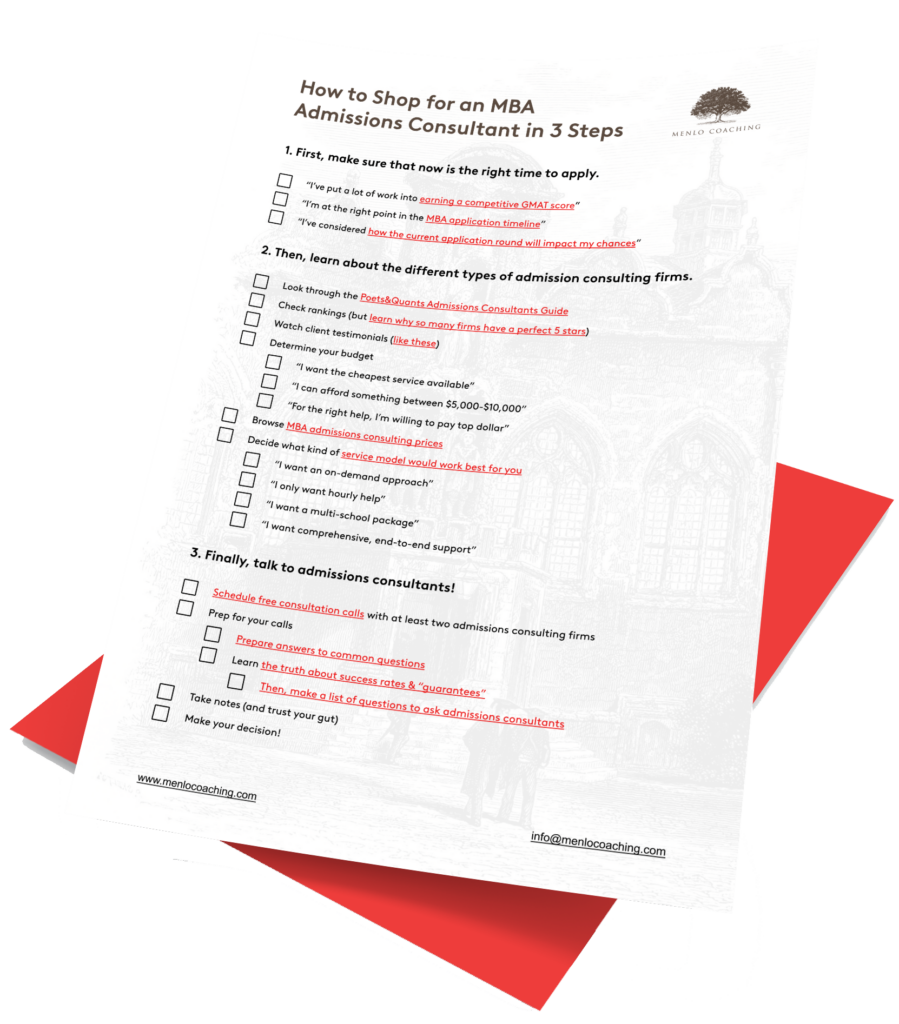
Our free, comprehensive checklist covers everything you need to shop for an MBA admissions consultant.